
Atomic Habits Review: Practical Lessons for Indian Readers
Many people want to improve their life, career, health, confidence, productivity, or money habits, but they often try to change everything at once. Atomic Habits by James Clear gives a simple and practical approach: improve by making small, consistent changes every day.
This review will help you understand what the book is about, who should read it, key lessons, practical applications, pros and cons, and whether Atomic Habits is worth reading for Indian readers.
Quick Verdict
Atomic Habits is one of the best beginner-friendly self-help books for building better habits and breaking bad habits. The book is practical, simple, and useful for students, working professionals, entrepreneurs, parents, and anyone who wants steady personal improvement.
| Point | Verdict |
|---|---|
| Best for | Beginners, students, professionals, self-improvement readers |
| Not ideal for | Readers looking for deep psychology or spiritual transformation |
| Difficulty level | Easy |
| Main theme | Building good habits through small daily improvements |
| Indian reader relevance | Very high |
| Overall rating | 4.5/5 |
Book Details
| Detail | Information |
|---|---|
| Book Name | Atomic Habits |
| Author | James Clear |
| Category | Self-help, productivity, habits, personal growth |
| Best for | Readers who want practical habit-building methods |
| Reading style | Simple, structured, practical, example-based |
What Is Atomic Habits About?
Atomic Habits is about making small changes that compound over time. The main idea of the book is that you do not need massive motivation to improve your life. Instead, you need a better system.
The book explains how habits work and how small improvements can create big results when repeated consistently.
In simple words, this book is about:
- Building good habits
- Breaking bad habits
- Designing your environment for success
- Becoming consistent
- Improving your identity through daily actions
- Focusing on systems instead of only goals
Why This Book Is Popular
The biggest strength of Atomic Habits is its simplicity. James Clear explains habit-building in a way that is easy to understand and easy to apply.
Many self-help books motivate you for a few days, but this book gives practical methods that you can actually use in daily life.
For example, instead of saying “be more disciplined,” the book explains how to make habits obvious, attractive, easy, and satisfying.
Who Should Read Atomic Habits?
This book is suitable for:
- Students who want better study habits
- Working professionals who want productivity and discipline
- Entrepreneurs who want consistency
- People trying to build a reading habit
- People trying to wake up early
- Readers who want to reduce procrastination
- Anyone who wants to improve health, learning, money habits, or career growth
- Beginners who are starting their self-help reading journey
Who Should Avoid This Book?
This book may not be ideal for:
- Readers who already know advanced habit psychology
- People looking for spiritual or emotional healing
- Readers who want deep neuroscience
- People expecting instant motivation or quick success formulas
- Readers who prefer story-based books instead of practical frameworks
If you want deep inner transformation, you may prefer books like Breaking the Habit of Being Yourself. But if you want a simple and practical starting point, Atomic Habits is a better first book.
Key Lessons from Atomic Habits
1. Small Habits Can Create Big Results
The book explains that small improvements may not look powerful in the beginning, but when repeated daily, they compound over time.
This is useful because many people quit early when they do not see immediate results. Atomic Habits teaches patience and consistency.
2. Focus on Systems, Not Only Goals
Goals are important, but systems are more important.
For example:
- Goal: Read 20 books this year
- System: Read 10 pages every night before sleeping
- Goal: Become fit
- System: Walk 30 minutes daily
- Goal: Improve career
- System: Learn one skill for 45 minutes daily
This lesson is very practical because success depends more on daily systems than occasional motivation.
3. Identity-Based Habits Are Powerful
The book says that real change happens when your habits become part of your identity.
Instead of saying:
“I want to read books”
You can say:
“I am a reader.”
Instead of saying:
“I want to become disciplined”
You can say:
“I am a disciplined person.”
This shift helps you act according to the person you want to become.
4. Make Good Habits Obvious
If you want to build a good habit, make it visible and easy to remember.
Examples:
- Keep a book near your bed
- Keep a water bottle on your desk
- Keep your study material ready before sleeping
- Keep your walking shoes near the door
- Keep your notebook open on your work table
When good habits are visible, you are more likely to follow them.
5. Make Bad Habits Difficult
If you want to stop a bad habit, make it harder to do.
Examples:
- Keep your phone away while studying
- Remove junk food from your room
- Log out from distracting apps
- Keep the TV remote away
- Avoid keeping unnecessary shopping apps on your phone
This idea is simple but powerful. Instead of depending only on willpower, design your environment properly.
6. Habit Stacking Can Help You Stay Consistent
Habit stacking means adding a new habit after an existing habit.
Examples:
- After morning tea, I will read 5 pages.
- After brushing my teeth, I will meditate for 2 minutes.
- After lunch, I will walk for 10 minutes.
- After opening my laptop, I will write my top 3 tasks.
This method is useful because it connects a new habit with an existing routine.
7. Make Habits Easy
Many people fail because they make habits too difficult in the beginning.
Instead of starting with a big target, start small:
- Read 2 pages
- Walk for 5 minutes
- Write 3 lines
- Save ₹50
- Study for 10 minutes
Once the habit becomes natural, you can increase it.
Where to Buy Atomic Habits
If you want a practical and beginner-friendly book on habits, discipline, and consistency, Atomic Habits is a strong starting point.
Check Latest Price on Amazon: Amazon
You may also like:
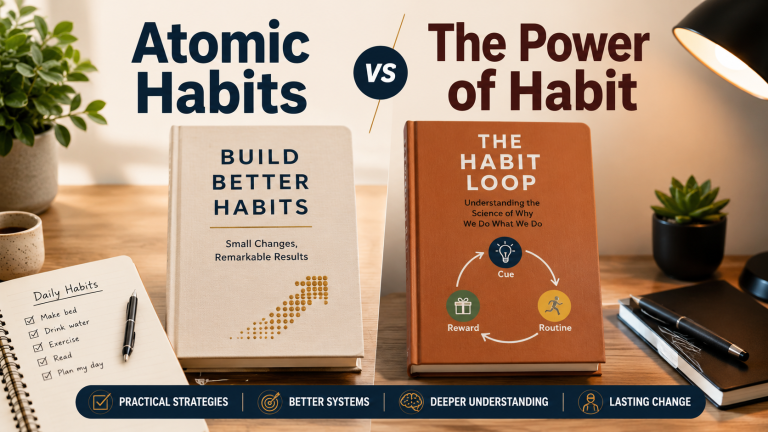
- Atomic Habits vs The Power of Habit
- Best Self-Help Books for Beginners in India
- How to Build a Reading Habit
Disclosure: Some links on this page may be affiliate links. If you buy through them, we may earn a small commission at no extra cost to you. We only recommend books and products that we believe are useful for readers.
Practical Applications for Indian Readers
Here are some practical ways Indian readers can apply Atomic Habits:
For Students
- Study for 25 minutes daily instead of waiting for exam pressure
- Keep books and notes ready before sleeping
- Use habit stacking after breakfast or evening tea
- Track daily study consistency
For Working Professionals
- Read 5 pages before sleeping
- Learn one professional skill daily
- Plan the next day before leaving work
- Keep phone notifications off during deep work
For Business Owners
- Track daily sales calls
- Spend 30 minutes on marketing every day
- Review business numbers weekly
- Build a daily learning habit
For Parents
- Read with children for 10 minutes daily
- Build a family reading routine
- Reduce screen time by changing the home environment
- Keep books visible in the house
For Personal Finance
- Save a fixed amount immediately after income
- Track expenses weekly
- Avoid impulse purchases by delaying decisions
- Read finance books regularly
Best Ideas from the Book
The most useful ideas from Atomic Habits are:
- You do not rise to the level of your goals; you fall to the level of your systems.
- Small habits become powerful when repeated consistently.
- Environment design is more reliable than motivation.
- Identity change is the foundation of lasting habit change.
- Make good habits easy and bad habits difficult.
Pros and Cons
Pros
- Very practical and beginner-friendly
- Easy language and clear examples
- Useful for students and professionals
- Gives actionable methods
- Strong focus on systems and consistency
- Good book to start a self-help reading journey
Cons
- Some ideas may feel familiar if you already read habit books
- It does not go very deep into emotional or spiritual transformation
- Readers must apply the ideas consistently to get results
- Some examples may feel repetitive in later chapters
Rating Breakdown
| Criteria | Rating |
|---|---|
| Practical value | 4.5/5 |
| Beginner friendliness | 5/5 |
| Writing style | 4.5/5 |
| Depth of ideas | 4/5 |
| Indian reader relevance | 4.5/5 |
| Re-read value | 4.5/5 |
Atomic Habits vs Breaking the Habit of Being Yourself
| Point | Atomic Habits | Breaking the Habit of Being Yourself |
|---|---|---|
| Best for | Practical habit building | Deep inner transformation |
| Difficulty | Easy | Medium |
| Style | Action-based | Reflective and meditation-based |
| Best reader | Beginners | Serious self-help readers |
| Main focus | Systems and behaviour | Thoughts, emotions, identity |
If you are new to self-help books, start with Atomic Habits. If you want deeper mindset and emotional transformation, read Breaking the Habit of Being Yourself later.
Similar Books You May Like
If you like Atomic Habits, you may also like:
- The Power of Habit by Charles Duhigg
- Deep Work by Cal Newport
- The 5 AM Club by Robin Sharma
- Essentialism by Greg McKeown
- The Compound Effect by Darren Hardy
- Breaking the Habit of Being Yourself by Dr. Joe Dispenza
Final Verdict
Atomic Habits is one of the best self-help books for beginners and practical readers. It is simple, structured, and useful for anyone who wants to build better habits and improve daily life.
For Indian readers, this book is especially useful because it can help students, professionals, business owners, parents, and self-improvement readers build discipline without depending only on motivation.
Final Recommendation
Read Atomic Habits if you want a practical, easy-to-understand book on habits, discipline, productivity, and personal growth.
Skip it only if you already know habit-building deeply and want a more advanced or spiritual book.
You can also read our detailed comparison: Atomic Habits vs The Power of Habit.